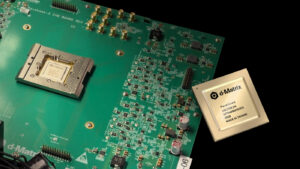
We’re thrilled to announce that the d-Matrix demo cloud—a hosted environment built so any customer, partner, or evaluator can experience the performance of Corsair-powered inference for themselves—is now available.
Select existing and potential customers can now see, in minutes, how our Corsair-enabled heterogeneous AI inference pipeline works on real production-grade models as capacity permits. We’re enabling the best way of evaluating your workloads with Corsair: getting it directly in your hands to try.
You can now spin up an inference endpoint on real Corsair hardware, point the OpenAI-compatible tools you already use at it, and watch heterogeneous inference perform against the workloads you care about.
d-Matrix Demo Cloud overview
The only thing standing between you and an ultra low-latency inference call is generating an API key. We give evaluators an OpenAI-compatible gateway, a curated model catalog, and the tooling to judge performance for themselves. Demo Cloud has been designed to support a wide range of inference endpoints such as Speculative decoding (SpecDec), attention-FFN disaggregation (AFD), and full model inference on Corsair.
Every tenant comes with a pre-provisioned workspace accessible through a convenient dashboard. From the moment you log in, you can see what’s deployed, what’s live, and where to go next. Everything is self-service, including API key management, to enable you to get your workloads running ASAP.
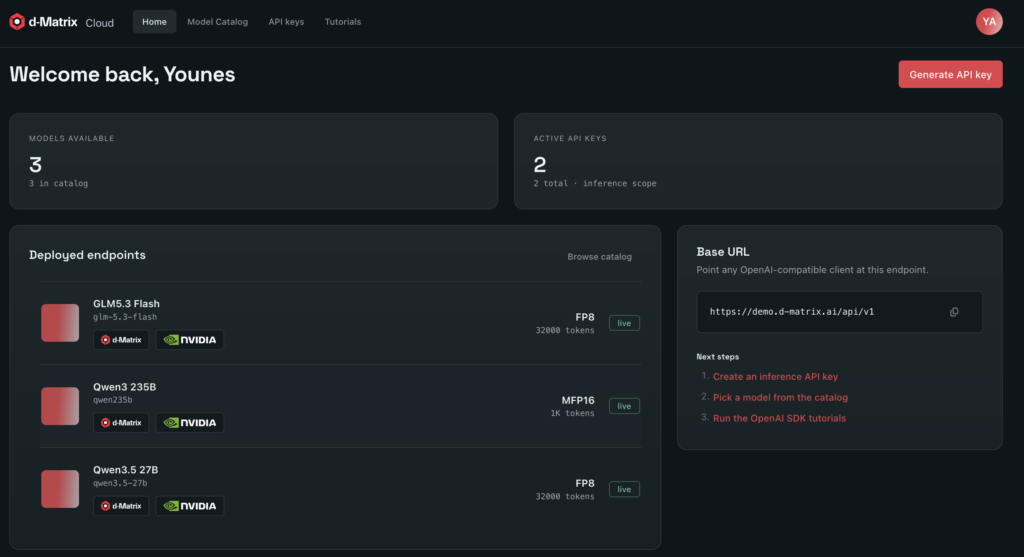
The home view: deployed endpoints, active API keys, and a base URL that any OpenAI-compatible client can point at.
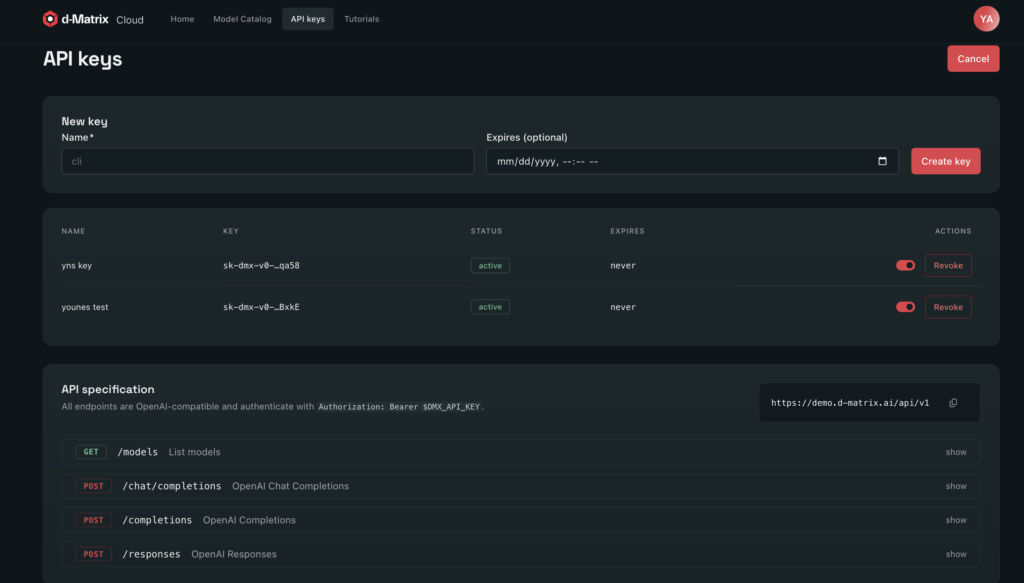
Generate a scoped inference API key, then authenticate against any endpoint with a standard Bearer token — the same pattern you already use with OpenAI’s SDK.
The d-Matrix demo cloud is designed to be plug-and-play. Every hosted model speaks the OpenAI wire protocol, and switching your existing client—chat completions, the Responses API, or an agentic coding tool like Codex CLI—over to d-Matrix is a config change, not a rewrite.
Point Codex CLI (or any OpenAI-compatible client) at the d-Matrix base URL by adding a provider block to your existing config — then run real coding tasks against a hosted model like Qwen3 235B.
Inference Endpoint Configurations
SpecDec, one of a wide range of inference endpoints in the d-Matrix demo cloud, is available to try today.
SpecDec runs a discrete draft model on Corsair that proposes tokens to a larger target model running on GPU. The GPU then verifies the draft tokens, enabling it to operate on a more parallelized workload that GPUs excel at.. The d-Matrix Demo Cloud runs this with full orchestration across Corsair and GPU nodes. You can see how this works in our breakdown of our GPU+Corsair SpecDec deployment.
The d-Matrix Demo Cloud inference endpoints come with pre-vetted deployment configurations to support different deployment modes, compute/memory allocation, and compatibility with chat completions and the Responses API.
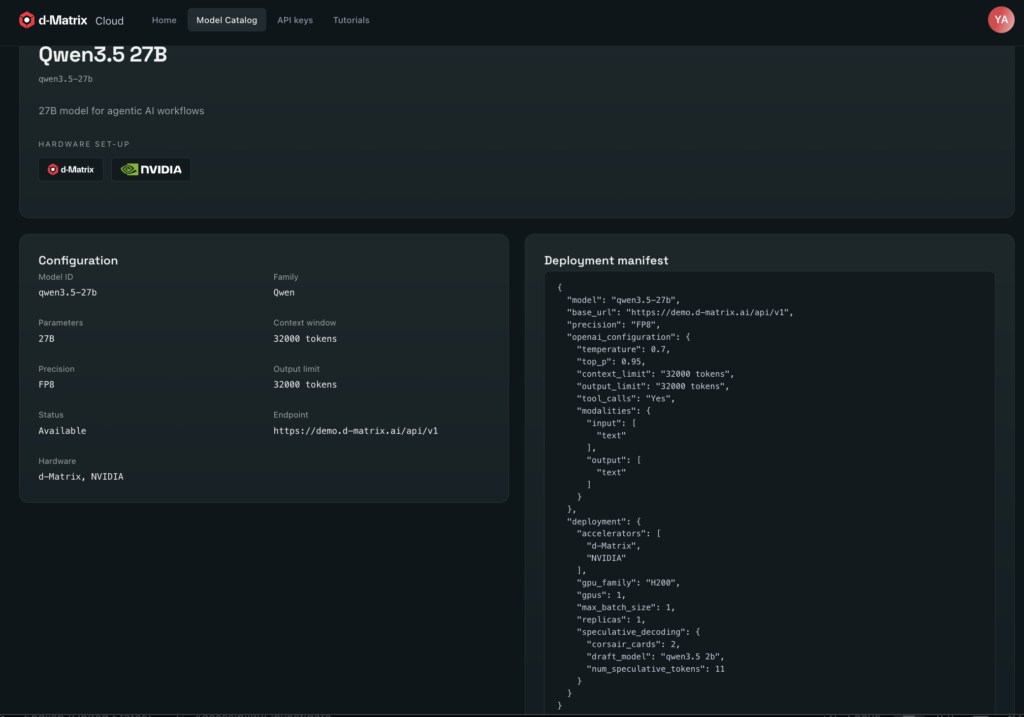
The Qwen3.5-27B model detail page in the d-Matrix Demo Cloud catalog, showing its deployment manifest — SpecDec inference mode with a small draft model on 2 Corsair cards and a Qwen3.5-27B target model on 1 H200 GPU.
Developer tool integrations
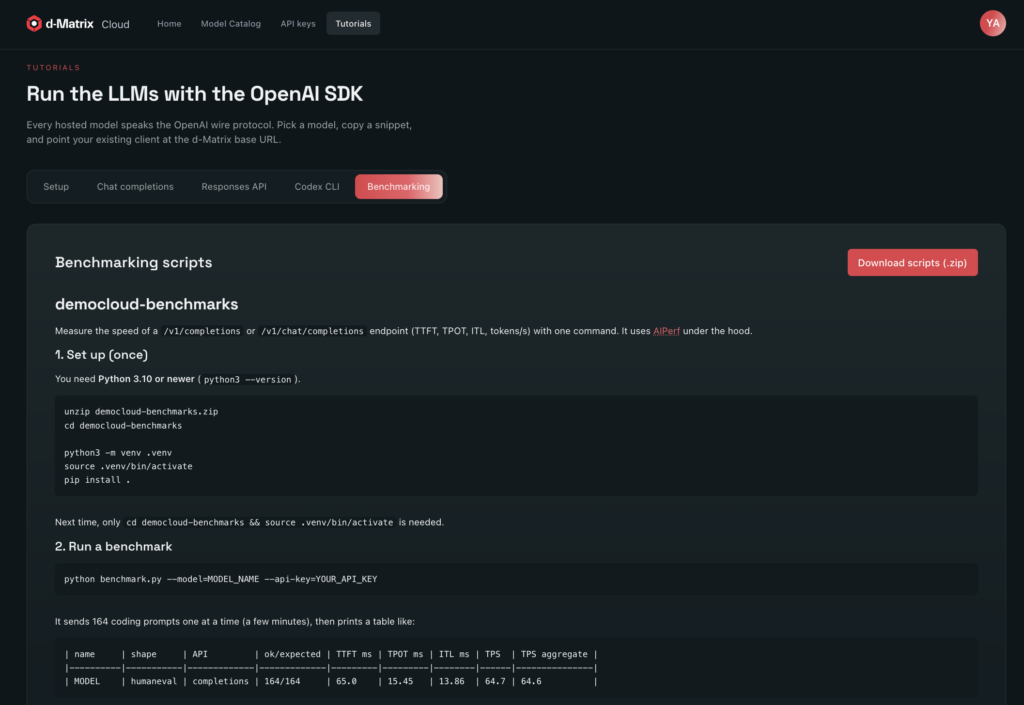
The d–Matrix Demo Cloud works off the OpenAI wire protocol to enable instant plug-and-play into existing OpenAI-configured pipelines. The Tutorials tab in the console includes copy-ready examples for each integration that are pre-filled with your base URL and a model from the catalog. Use them to send your first request with the Responses API, point Codex CLI at a hosted model for real coding tasks, and benchmark an endpoint with AIPerf to see latency and throughput for yourself.
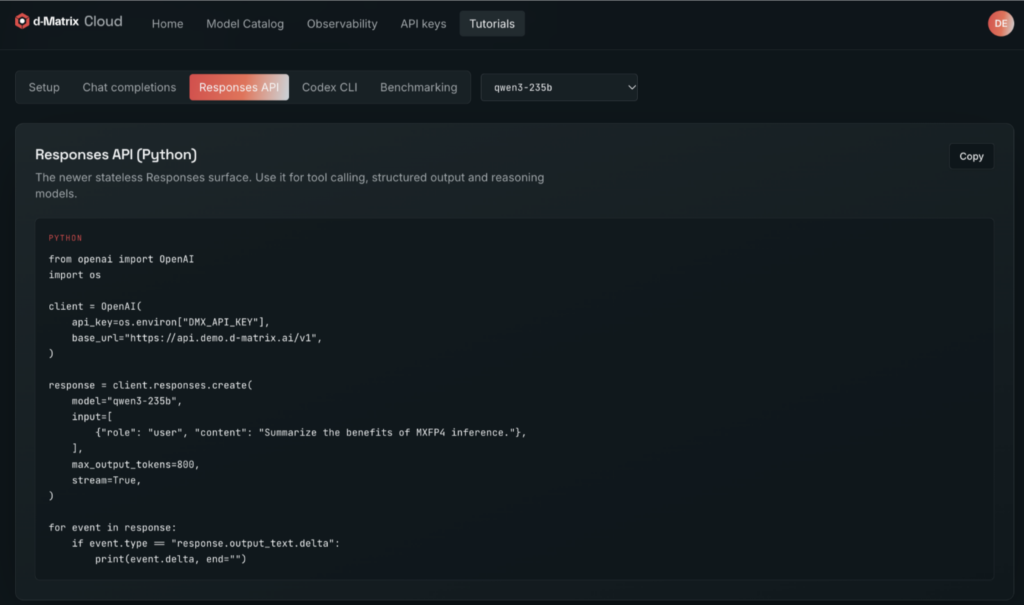
The Tutorials tab opens with the Responses API: a ready-to-copy Python snippet that sets your d-Matrix API key and base URL, selects a model such as Qwen3 235B, and streams the response.
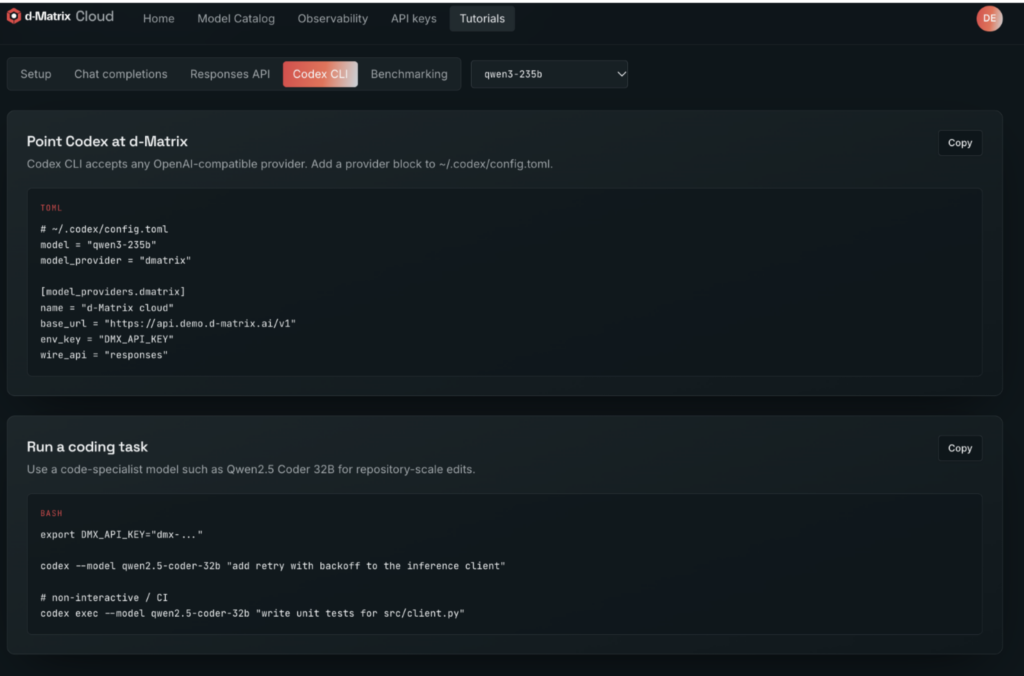
The Codex CLI tutorial: add a d-Matrix provider block to ~/.codex/config.toml, then run interactive or non-interactive coding tasks against a hosted model.
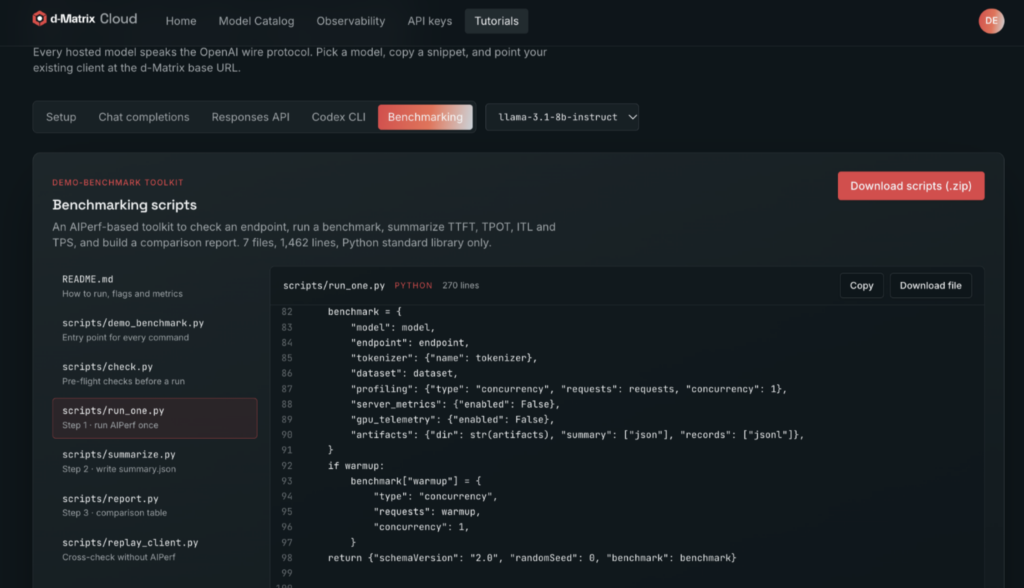
The Benchmarking tutorial: install AIPerf and run a quick streaming profile against your endpoint to measure time to first token (TTFT), inter-token latency (TPOT) and per-user throughput.
d-Matrix Demo Cloud Architecture
The d-Matrix Demo Cloud provides a single inference gateway that fronts a Kubernetes-based serving fleet built on d-Matrix Squadron. Requests flow top to bottom through four layers with a provisioning plane running underneath.
Entry point and gateway. Applications, agents and SDKs call one OpenAI-compatible endpoint. The gateway terminates TLS at the edge (the red badge in the diagram seen below) and then applies four functions:
- API keys: issuance and rotation.
- Users and orgs: access and entitlement management.
- Model router: policy-based selection of the backend for each request.
- Telemetry: throughput and latency data, including TTFT, TPOT, and tok/s/user.
Clients only ever see one endpoint, regardless of how many models or serving strategies sit behind it.
Kubernetes deployment operator. Between the gateway and the cluster sits a Kubernetes deployment operator. It turns routing and deployment intent into running inference endpoints.the gateway and the serving fleet stay decoupled. Models can be added, moved or scaled without changing anything on the client side.
d-Matrix Squadron cluster. The backend is a Kubernetes cluster that supports three endpoint types, each a different way of serving a model:
- Heterogeneous SpecDec endpoints (available today): heterogeneous pipelines serving with speculative decoding. A fast draft step proposes several tokens ahead, and the target model verifies them in a single pass. When the draft is accurate, this cuts per-token latency without changing the model’s output. We can achieve 476.4 tokens per second per user in a configuration deploying Qwen3-1.7B as a draft model against Qwen 235B as a target model.
- Heterogeneous AFD endpoints (coming soon): heterogeneous pipelines serving with attention-FFN disaggregation. The attention and feed-forward stages of the model run as separate pipeline stages, so each can run on the hardware best suited to it. We can deliver 845 tokens per second per user at batch size 1 with GPT-OSS-20B. (See more about how we achieved AFD with Corsair here.)
- Corsair endpoints (coming soon): inference whole models served directly on Corsair.
These endpoints run on dedicated d-Matrix node pools made up of Corsair, JetStream and NVIDIA hardware. The pools can scale up within a system and scale out across systems, so heterogeneous pipelines are deployed as first-class Kubernetes workloads instead of one-off integrations.
Provisioning plane. Beneath the cluster, the provisioning plane (GitOps, operators, autoscalers and a model registry) handles the lifecycle. It deploys endpoints, scales node pools and keeps the registry current, so the gateway routes only to endpoints that are available.
Why this shape. The design separates concerns. The gateway owns identity, security and routing policy. The operator and provisioning plane own deployment and capacity. The cluster owns execution. Because the endpoint types differ in latency and cost, the model router can choose between them per request, for example sending latency-sensitive traffic to a speculative-decoding endpoint.
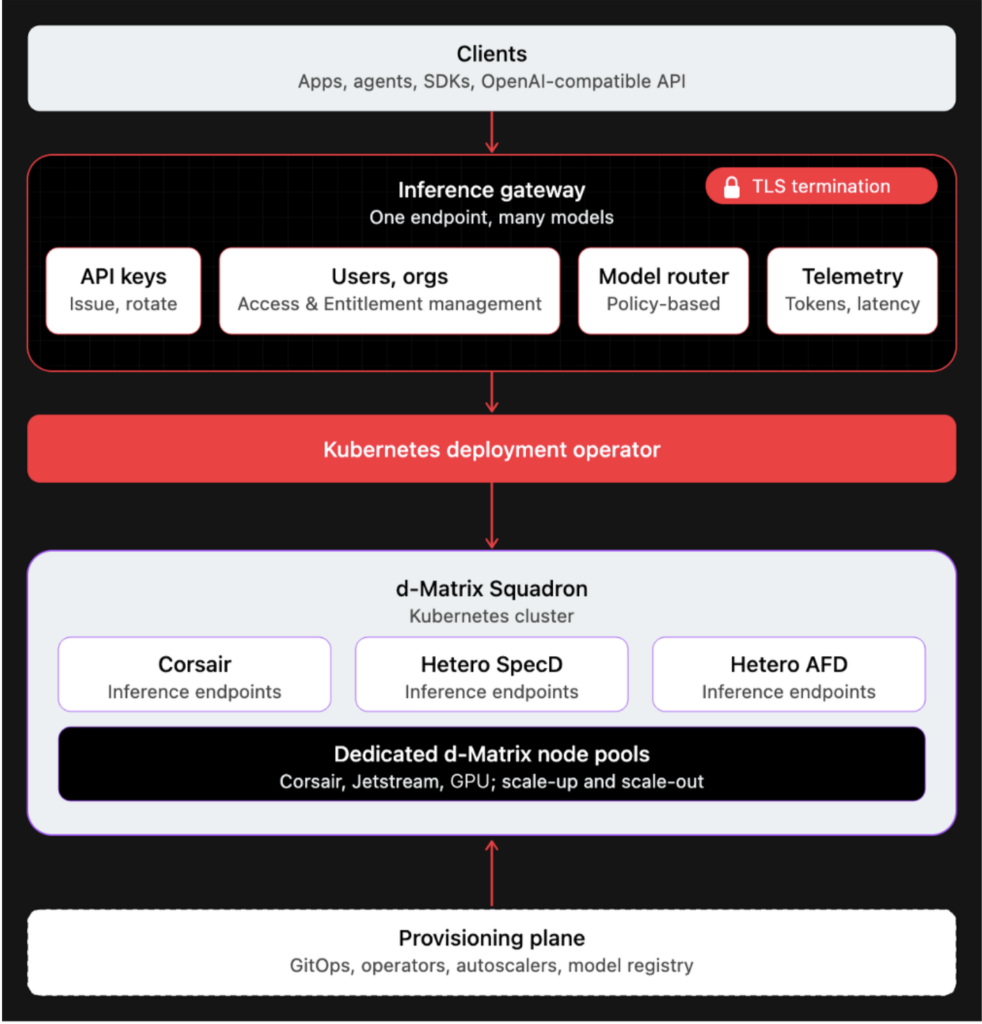
The d-Matrix Demo Cloud architecture: clients reach a single OpenAI-compatible inference gateway (API keys, users and orgs, model router, telemetry), which hands off to a Kubernetes deployment operator and the d-Matrix Squadron cluster of Corsair, Hetero SpecD and Hetero AFD endpoints, with a provisioning plane managing the layers beneath.
The d-Matrix Demo Cloud is built on the integration of Wallaroo.ai, whose AI inference deployment and orchestration software and engineering team joined d-Matrix in August. Wallaroo’s expertise in Kubernetes operations and AI inference systems is what lets us turn heterogeneous Corsair and GPU deployments into endpoints you can evaluate in minutes and gives customers a simpler path from evaluation to production-scale inference. Read more in the announcement of our acquisition of Wallaroo.ai.
What’s next?
If you’re evaluating inference infrastructure — whether you’re an enterprise, neocloud, an inference platform, or a partner looking to benchmark heterogeneous compute against your current stack — this is the fastest way to evaluate d-Matrix Corsair in action against production models, with zero infrastructure lift on your side. This evaluation becomes the foundation for a deployment in your own environment with more confidence about what heterogeneous inference buys you.
Capacity is limited and Access is gated through the d-Matrix team to make sure every evaluator gets a properly configured dedicated allocation of Corsair and GPU capacity to see the true potential of AI inference powered by Corsair.